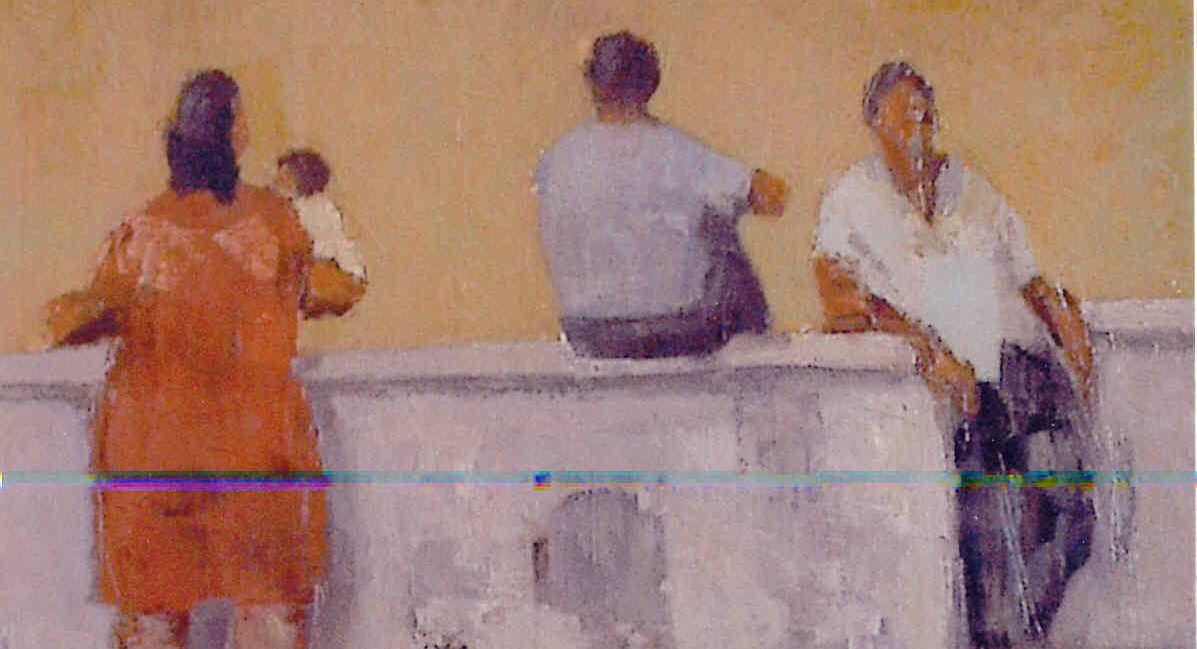
By then, as the family settled in the “Street of the artists” in Rome, Via Margutta, carlo dedicated himself to his artistic passion, which would have him prisoner until his death. This is the time when his style matured through the contact with many of the most significant artists of the “Scuola Romana”, and by developing a personal style, which can be well identified in some of his works.
Some typical themes began to be represented in his works: the views of Rome, Venice, the Riviera, and mostly of the island of Ponza, where the family built their holiday home in 1953. The violent landscapes of the latter place inspired the artist, in many paintings and in a large quantity of drawings – most in black pencil or with a minimum touch of colour, drawn “dal vero” in few expressive strokes.
Here his palette develops in expressionistic mode, the violent red or purple skies, the multiple ochre tones of the rocks.
Another favorite theme of the mature years are the scenes of people: card players around a table, old peasants and fishermen idle, sitting on a low wall (his famous “muretti”), old faces captured and almost transformed into monsters. Still life images also attracted him, always dramatically transfiguring the objects.
Although his representation of the world was contemporary and expressionistic, the study of the old masters frequently appears in many of his works. An avid book collector, and a passionate visitor to all the great Museums in Italy, France, Spain, the Netherland, England (during the 60s and 70s he visited the Louvre almost yearly, each time spending several days in a row inside the galleries), he interpreted several masterpieces through sketches that fill the innumerable booklets and albums he left. He always carried one of these booklets and a pen in his pocket, quick to capture images, or to note down impressions, comments, memories and opinions.
Carlo Fontana was not eager to exhibit publicly his work: in fact, one can count less than twenty exhibitions, either personal or collective, where he faced the public scrutiny. The need promote oneself and to court political favour, disgusted him to the point where he reached the conclusion, after 1970, that such was not his game. He continued to sell a small number of his works privately, mostly to a small circle of acquaintances who understood the passion transmitted through his images.