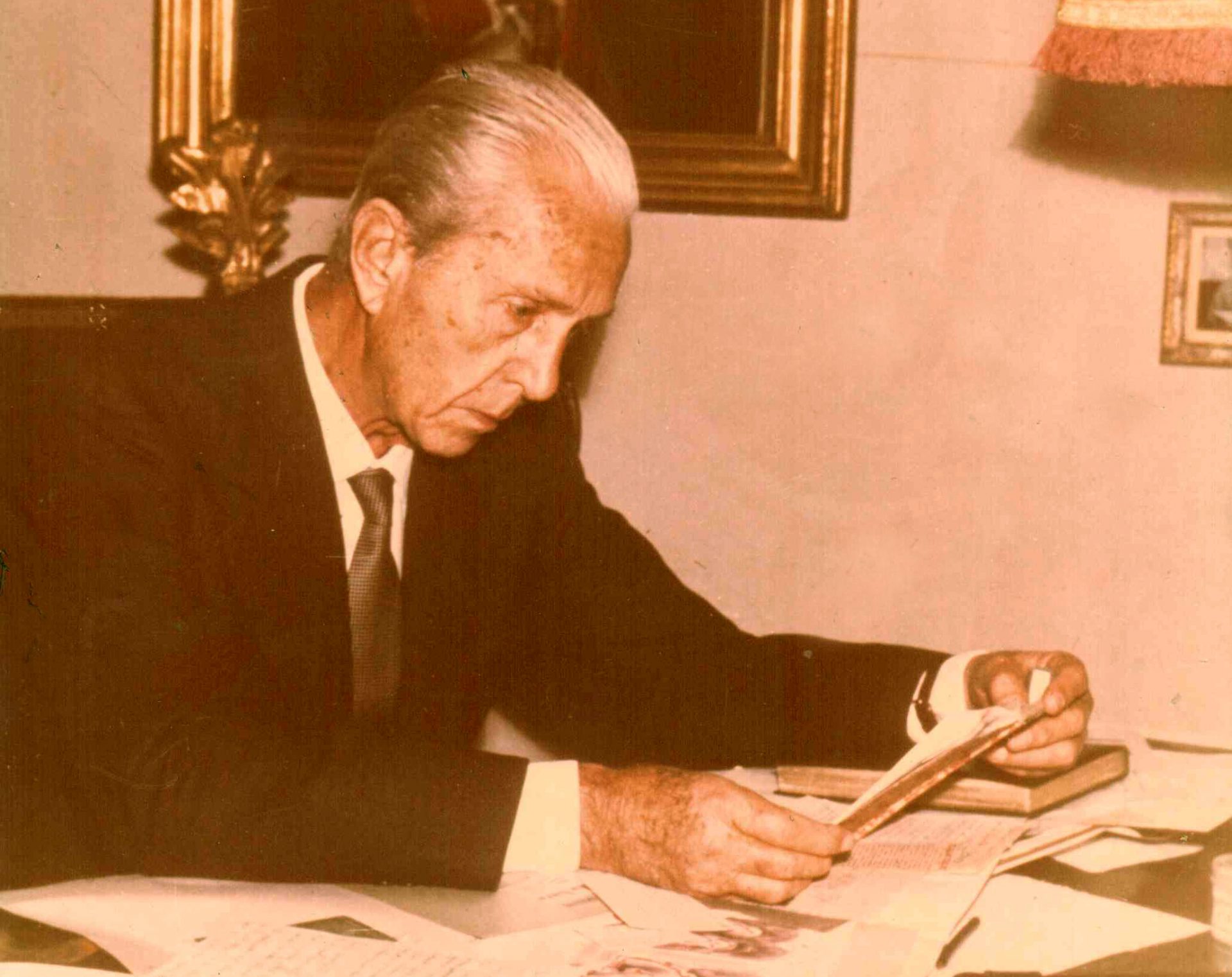
Carlo Augusto Fontana was born in Rome, Italy, on September 13, 1897. Although there were no artistic roots in the family, he showed interest and early skill in drawing since the years spent at a boarding school near Rome. After taking part as a junior officer to World War I, being wounded and taken to military hospital, he entered law school at the University of Rome. As he graduated, he was promptly hired by a well-known law firm in Rome: his results were mixed, apparently because he hated this job, which he quit without regrets.
Spurred by his early art interest, Carlo Fontana had a brief apprenticeship with Armando Spadini in Rome; but the very conservative style of the master could not suit the artistic orientation of the unruly pupil. Between the mid-20s and the early 30s, the artistic passion being temporarily set aside, Carlo had a brief career as a movie actor in Italy and in Germany, and discovered a new love: sailing. He crisscrossed the Mediterranean solo on a small sailboat, at a time when pleasure yachting was still a rarity. After his second marriage in 1934, the passion for drawing and painting caught him again; the early mature years were marked by the birth of his two children, and as Italy was at war again, by spending seven months in Libya, where he was wounded and repatriated in 1940.
As the family settled in Rome, by finally dedicating himself to his artistic passion, Carlo Fontana was in contact with many artists of the “Scuola Romana” (Roman School), and developed his personal style, which can be well identified in his works.
The “Scuola Romana” was an Expressionist art movement created by a group of painters active in Rome between 1928 and the mid-1950s. The most significant artists in this group were Mario Mafai, Scipione, Marino Mazzacurati, Corrado Cagli, Renzo Vespignani, Renato Guttuso, Afro and Mirko Basaldella, Raffaele Frumenti, Sante Monachesi, Giovanni Omiccioli, Toti Scialoja and the so-called tonalists led by Corrado Cagli, Carlo Levi, Emanuele Cavalli and Giuseppe Capogrossi.
Visually, some of the characteristic styles of paintings from these artists include a vivid and wild painting palette, expressive and disorderly, violent and with warm ochre and maroon tones. The formal rigour was replaced by a distinctly expressionist vision.
As for Carlo Fontana, some typical themes began to be represented in his works: the views of Rome, Venice, the Riviera, scenes of people (card players, old peasants and fishermen) and mostly of the island of Ponza, where he spent the summers from 1951 to his death. The violent landscapes of the latter place inspired the artist, in many paintings and in a large quantity of drawings – most in black pencil or with a minimum touch of colour, drawn in few expressive strokes. Here his palette develops in personal, expressionistic mode, the violent red or purple skies, the multiple ochre tones of the rocks.
Although his representation of the world was contemporary and expressionistic, the study of the old masters frequently appears in many of his works.
Carlo Fontana was not eager to publicly exhibit his work: in fact, one can count less than twenty exhibitions, either personal or collective, where he faced the public scrutiny. He mostly sold his works privately, to art dealers in Italy and elsewhere: His works – canvases as well as drawings – can be found in several private collections in Italy, Switzerland, France, Lebanon, Brazil, Greece, United States, Canada, Argentina and Mexico, as well at the National Gallery of Modern Art in Rome.
He continued to paint, draw, and write his notes until his death, following a fall in Ponza, on December 10, 1982.